<?xml version="1.0" encoding="utf-8"?><feed xmlns="http://www.w3.org/2005/Atom" ><generator uri="https://jekyllrb.com/" version="3.10.0">Jekyll</generator><link href="https://it.maggio.xyz/feed.xml" rel="self" type="application/atom+xml" /><link href="https://it.maggio.xyz/" rel="alternate" type="text/html" /><updated>2026-09-02T00:37:50-07:00</updated><id>https://it.maggio.xyz/feed.xml</id><title type="html">Ctrl+Click: AI &amp;amp; IT Solutions</title><subtitle>Notes from ⌃click on AI adoption, secure networking, email migrations, cloud infrastructure, and everyday tech, for people, businesses, and their teams in the Bay Area.</subtitle><author><name>⌃click</name></author><entry><title type="html">Where Does Our Data Live When AI Is Everywhere?</title><link href="https://it.maggio.xyz/blog/where-does-our-data-live-when-ai-is-everywhere/" rel="alternate" type="text/html" title="Where Does Our Data Live When AI Is Everywhere?" /><published>2026-09-02T00:30:00-07:00</published><updated>2026-09-02T00:30:00-07:00</updated><id>https://it.maggio.xyz/blog/where-does-our-data-live-when-ai-is-everywhere</id><content type="html" xml:base="https://it.maggio.xyz/blog/where-does-our-data-live-when-ai-is-everywhere/"><![CDATA[<p>I thought I was asking a storage question.</p>

<p>Where should my AI data live? In ChatGPT? Claude? A folder on my computer? A private GitHub repository? Inside whichever agent harness I happen to be excited about this week?</p>

<p>Storage is only the visible part. The real question is <strong>continuity</strong>.</p>

<p>If I spend months teaching an AI how I work, what I care about, how my business operates, and which assumptions it should never make, who owns that accumulated understanding? Can I carry it to another model? Can I inspect it? Correct it? Still use it if one company changes its product, raises its price, or disappears?</p>

<p>Put more simply: is the AI remembering me, or am I building a memory that AI can use?</p>

<p>Those sound similar. They lead to very different systems.</p>

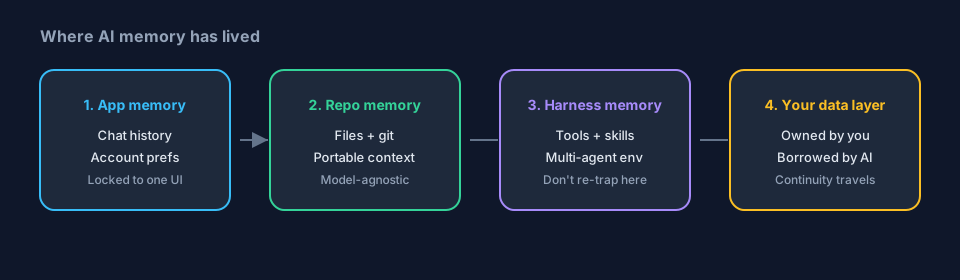
<p><img src="/assets/blog/ai-memory-phases.svg" alt="Four phases of AI memory: app, repository, harness, and a user-owned data layer" /></p>

<h2 id="phase-one-memory-lived-inside-the-app">Phase one: memory lived inside the app</h2>

<p>For most people, personal AI began in a chat window. Conversation history came first. Then account-level memory: preferences, recurring facts, custom instructions, project spaces.</p>

<p>That was a real upgrade. An AI that knows your business or writing style beats one that wakes up blank every morning.</p>

<p>It also created a new kind of lock-in. The context belonged to the experience. Switch providers and you export, paste, rebuild, or introduce yourself again to a machine you had supposedly been working with for months.</p>

<p>We made the model smarter. Our continuity stayed trapped inside an interface.</p>

<h2 id="phase-two-the-repository-became-the-memory">Phase two: the repository became the memory</h2>

<p>AI-assisted development changed the shape of this for me.</p>

<p>Once coding agents entered the picture, important context moved out of the chat and into the project. The repository held the code, and it also started holding instructions, architecture decisions, plans, conventions, and docs the agent needed to do good work.</p>

<p>A model could read <code class="language-plaintext highlighter-rouge">README.md</code>, follow standing guidance, make a change, and commit. Open the same repo with a different model tomorrow and continue.</p>

<p>The chat stopped being the source of truth. The files did. The model became a temporary worker arriving at a shared job site.</p>

<p>That is one reason Markdown matters so much in AI workflows. A person can read it. A model can read it. Git can diff it. It does not become unusable because one company goes away. JSON and YAML are better for rigid records. Markdown is better for meaning that still needs a human voice.</p>

<p>The combination started to look less like documentation and more like portable memory.</p>

<h2 id="phase-three-the-harness-became-the-environment">Phase three: the harness became the environment</h2>

<p>Then came the harnesses.</p>

<p>Tools such as Clawdbot, Hermes, Grok Bot, and whatever arrives next do more than wrap a chat box around a model. They manage the environment: tools, skills, permissions, standing instructions, caches, projects, and sometimes whole teams of specialized agents.</p>

<p>I wrote recently that <a href="/blog/grok-bot-and-the-multi-agent-team/">a model on its own is a brilliant amnesiac</a>. A harness is what gives that brilliance a place to work. It can choose which model handles a task, load the right guidance, expose the right files, and coordinate specialists. Suddenly the provider matters less.</p>

<p>But that makes the data question more urgent, not less.</p>

<p>If my instructions, history, and working knowledge live inside one harness, I have only moved the lock-in up one layer. I escaped the model provider and built the same trap somewhere else.</p>

<p>The harness should be replaceable too.</p>

<p>That leads to a principle I am increasingly convinced of:</p>

<blockquote>
  <p>Your AI should not own your memory. You should own a memory your AI can borrow.</p>
</blockquote>

<h2 id="git-is-not-github-and-local-first-is-not-local-only">Git is not GitHub, and local-first is not local-only</h2>

<p>When I say my data lives in GitHub, I may mean three different things:</p>

<ul>
  <li>The data is stored as ordinary files.</li>
  <li>Git records the history of those files.</li>
  <li>GitHub hosts a remote copy and gives tools a way to access it.</li>
</ul>

<p>Those layers are useful together. They are not the same thing.</p>

<p>Git is a format and a history system. GitHub is a service. A local folder is a copy on one machine. A backup is another copy with a recovery purpose. A harness is an interface and an operator. A model is compute.</p>

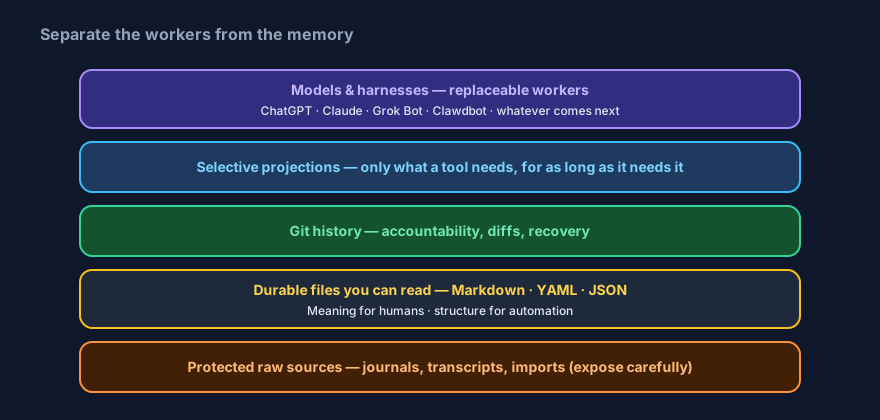
<p><img src="/assets/blog/data-layers-stack.svg" alt="A stack that keeps replaceable models and harnesses above selective projections, git history, readable files, and protected raw sources" /></p>

<p>Once those responsibilities are separated, the architecture gets easier to reason about.</p>

<p>For a software project, a private GitHub repository may be an excellent canonical home. For the most personal parts of a life, the answer may be different. Highly sensitive records may belong in an encrypted local store, with carefully chosen projections made available to cloud tools. The model rarely needs every fact. It needs the right context for the task.</p>

<p>Local-first does not mean one precious laptop holding the only copy of your life. That is not privacy. That is a future hard-drive tragedy.</p>

<p>Local-first means the system remains coherent, readable, and useful without needing permission from a particular service. It can still sync, back up, and use powerful cloud models. The service is just not the only place where the truth exists.</p>

<h2 id="then-this-collided-with-life-journal">Then this collided with Life-Journal</h2>

<p>I have been building a personal operating system called <a href="/blog/one-life-written-down-once/">Life-Journal</a>. The premise was simple: write one journal entry, then let the system maintain useful context across the rest of my life.</p>

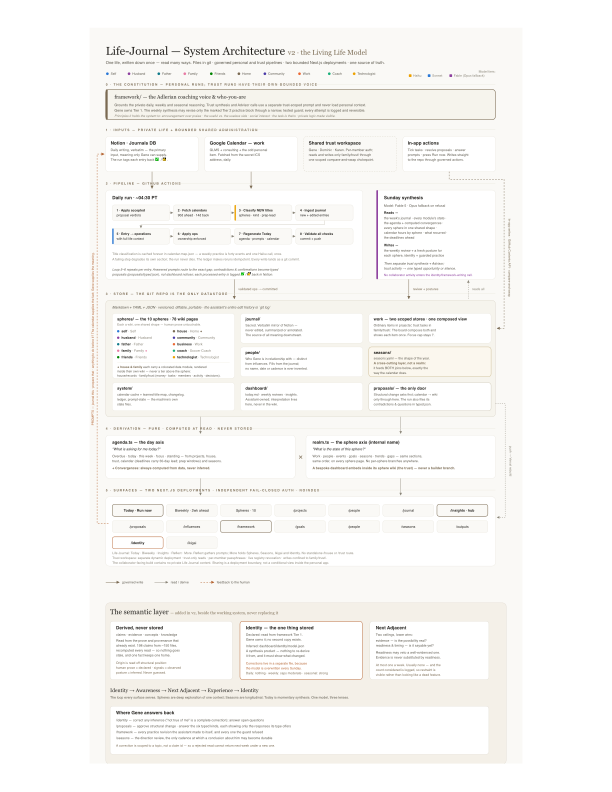
<p><img src="/assets/blog/lifejournal-architecture.svg" alt="Life-Journal system architecture" /></p>

<p>The journal feeds human-readable wikis. Those pages track roles, projects, people, commitments, and patterns. The same material can produce a daily view, a role-based view, or a weekly synthesis. I chose a wiki over a vector database because I wanted the memory of my own life to be something I could open, read, edit, and challenge.</p>

<p>At the time, I thought I was making a decision about my journal.</p>

<p>Now I think I was accidentally designing the same data layer that agent harnesses need.</p>

<p>The collision got obvious when I imagined a chief-of-staff agent directing specialists across work and life. A coding agent might need technical preferences. A business agent might need to understand Growing Light Montessori School. A family assistant might need calendar context. A coaching agent might need goals and recent reflections.</p>

<p>None of those agents should maintain its own separate Gene database. That way lies duplicated facts, contradictions, and a great deal of me repeating myself to robots.</p>

<p>They need shared context with boundaries.</p>

<p>The life system should own the durable knowledge. Each agent should receive the portion it needs, for the period it needs it, with clear permission to read, propose, or write.</p>

<p>That is not just a personal journal architecture. It is a personal data architecture.</p>

<h2 id="wiki-and-database-layered">Wiki and database, layered</h2>

<p>People and models benefit from readable summaries. Software benefits from predictable structure. Trying to force everything into one format usually makes one side miserable.</p>

<p>The best shape I have found is layered:</p>

<ul>
  <li><strong>Markdown</strong> for explanations, narratives, decisions, identity, and curated knowledge.</li>
  <li><strong>YAML or JSON</strong> for records that need consistent fields, validation, dates, relationships, or automation.</li>
  <li><strong>Raw source material</strong> preserved separately: journal entries, transcripts, calendar imports, documents.</li>
  <li><strong>Computed views</strong> generated from the source, rather than stored as competing versions of the truth.</li>
</ul>

<p>A person can audit the Markdown. An agent can read it. Git can show exactly what changed. Structured records exist because some facts need rules. A due date should be a date. A dollar amount should not become “about a few thousand” because a model felt poetic that morning.</p>

<p>Human-readable and machine-reliable are not competing goals. They belong in different layers.</p>

<h2 id="folders-by-object-not-by-every-role-you-play">Folders by object, not by every role you play</h2>

<p>My first instinct was folders for every realm of life: family, work, coaching, home, health, community. Familiar. Also fragile. One fact often belongs in several places. Copy it seven times and you get seven future disagreements.</p>

<p>The more durable structure is based on what a thing <em>is</em>:</p>

<ul>
  <li>People</li>
  <li>Projects</li>
  <li>Organizations</li>
  <li>Events</li>
  <li>Places</li>
  <li>Assets</li>
  <li>Knowledge</li>
  <li>Systems</li>
  <li>Goals</li>
</ul>

<p>Store a thing once. Connect it to the roles, contexts, and views where it matters.</p>

<p>Husband, father, coach, business owner, and community member are not necessarily storage folders. They are lenses. The objects are relatively stable. The views can evolve. That is a better bargain than rebuilding the filing cabinet every time my understanding of myself changes.</p>

<h2 id="where-i-think-this-goes-next">Where I think this goes next</h2>

<p>Account memory. Repository memory. Harness memory. The next phase is a <strong>user-owned data layer</strong> beneath all of them.</p>

<p>It will probably be local-first, synchronized, versioned, and selectively available. It will mix readable documents with structured records. It will preserve provenance, so the system knows whether something came from me, a calendar, a bank statement, or an AI inference. It will treat permission as part of the data model.</p>

<p>Most importantly, it will separate facts from interpretations.</p>

<p>An agent may infer that I am overcommitted. It should show me the evidence. It should not silently rewrite my identity. A new model may be better at synthesis than the old one. It should read the same underlying record without requiring me to start from an empty prompt.</p>

<p>Eventually the interface may become almost incidental. Chat window, terminal harness, phone dashboard, or an agent that has not been invented yet. Those are windows into the system. They are not the system itself.</p>

<h2 id="the-practical-answer-for-now">The practical answer, for now</h2>

<p>I do not think there is one perfect place where all AI data should live today. My working answer:</p>

<ol>
  <li>Keep durable knowledge in open, human-readable formats.</li>
  <li>Use structured files where automation needs guarantees.</li>
  <li>Use git for history and accountability.</li>
  <li>Use a remote host such as GitHub for sync and collaboration when sensitivity permits it.</li>
  <li>Keep raw personal source material protected and expose only what a tool needs.</li>
  <li>Treat models and harnesses as replaceable workers, not permanent owners of context.</li>
  <li>Generate views from the source instead of maintaining multiple competing truths.</li>
</ol>

<p>That is not a finished standard. We are still early enough that everyone is inventing parts of this independently, usually in a collection of Markdown files with names like <code class="language-plaintext highlighter-rouge">CONTEXT-FINAL-v3.md</code>.</p>

<p>But the direction feels clear.</p>

<p>The most valuable part of an AI relationship is not the conversation happening right now. It is the continuity that makes the next conversation better. If that continuity matters, it should not exist only inside somebody else’s product.</p>

<p>Control-click on the AI interface and look underneath. The model is only one option in the menu. Your data, your history, your permissions, and your ability to leave are the parts that determine whether the system actually belongs to you.</p>

<p>That is where I started with Life-Journal, almost by accident. One life, written down once, read many ways.</p>

<p>Now I am wondering whether the same principle should apply to everything.</p>

<p>If you are wrestling with the same questions for your business systems, your team agents, or your own personal context, <a href="https://calendar.app.google/QtYaUwA72XbuKN468">come say hi</a>. That is exactly the kind of problem I like thinking through.</p>]]></content><author><name>⌃click</name></author><summary type="html"><![CDATA[AI memory started inside apps, moved into repositories, and is now being pulled through agent harnesses. The real question is continuity: who owns the context, and can you take it with you?]]></summary></entry><entry><title type="html">Merlin, Link, and a Chief of Staff: Building a Multi-Agent Team with Grok Bot</title><link href="https://it.maggio.xyz/blog/grok-bot-and-the-multi-agent-team/" rel="alternate" type="text/html" title="Merlin, Link, and a Chief of Staff: Building a Multi-Agent Team with Grok Bot" /><published>2026-08-31T07:00:00-07:00</published><updated>2026-08-31T07:00:00-07:00</updated><id>https://it.maggio.xyz/blog/grok-bot-and-the-multi-agent-team</id><content type="html" xml:base="https://it.maggio.xyz/blog/grok-bot-and-the-multi-agent-team/"><![CDATA[<p><img src="/assets/blog/grokbot-merlin.png" alt="Merlin, the wise guide: a pixel-art wizard with a long white beard and a gnarled staff, standing in a mossy forest" /></p>

<p>Ask most people what makes AI coding good and they’ll name a model. Claude. Codex. Gemini. Grok. Fair enough, the models are extraordinary. But after enough hours in the chair, I’ve come to believe the model is the <em>least</em> interesting part of the setup. The interesting part is the <strong>harness</strong>: the environment that wraps the model, feeds it context, remembers what it’s supposed to do, and lets it act.</p>

<p>This is a post about that harness, about a tool called <strong>Grok Bot</strong> that leans into it, and about a slightly ridiculous, genuinely useful idea I’ve been building toward for a while: a team of named AI agents, each with a personality and a job, all reporting to a chief of staff.</p>

<p>Let me explain by way of a wizard, an elf scout, a boy general, an inventor, and a detective.</p>

<h2 id="what-a-good-harness-actually-buys-you">What a good harness actually buys you</h2>

<p>A model on its own is a brilliant amnesiac. It’s smart in the moment and forgets everything the second the moment ends. A good harness fixes that. It’s the coding environment that lets you:</p>

<ul>
  <li><strong>Integrate multiple models and features</strong> behind one consistent interface, so you’re not rebuilding your workflow every time you switch tools.</li>
  <li><strong>Layer in skills and <code class="language-plaintext highlighter-rouge">.md</code>-based guidance documents</strong>, standing instructions the agent reads automatically, so you’re not re-typing the same context every session. Write down “here’s how we do database migrations” once, and every agent that touches the repo knows it.</li>
  <li><strong>Cache aggressively and keep the environment consistent</strong>, so the agent starts each session in a known-good state instead of re-deriving your whole project from scratch.</li>
</ul>

<p>That last point is the quiet superpower. Caching and a consistent environment aren’t glamorous, but they’re what turn “an AI that can write code” into “an AI that can do <em>my</em> work.” You stop prompting constantly and start delegating.</p>

<p>And once you’re delegating, a natural question follows: why delegate to one agent when you could have a whole team?</p>

<h2 id="enter-grok-bot">Enter Grok Bot</h2>

<p><img src="/assets/blog/grokbot-logo.jpg" alt="The Grok Bot logo: a simple, friendly white face on a black background" /></p>

<p>Grok Bot leans all the way into that question. It lets you spin up <strong>multiple agents</strong> and, crucially, <strong>personalize</strong> each one. Different guidance, different specialties, different names.</p>

<p>That personalization matters more than it sounds. An agent that is <em>only</em> a database specialist, with only database guidance loaded and a name that reminds you what it’s for, tends to behave like a better database specialist. Specialization is a feature, not just a vibe. Narrow the job and you narrow the mistakes.</p>

<p>Months before Grok Bot, I’d already made a list, half for fun, half in earnest, of AI agents modeled on characters from literary and mythological history. Now I finally had somewhere to put them.</p>

<h2 id="the-roster">The roster</h2>

<p>Here’s the crew I’ve been assembling. Each character is chosen so the <em>name itself</em> signals the job. When I hand work to “Sherlock,” I already know what I’m going to get.</p>

<p><img src="/assets/blog/grokbot-link.png" alt="Link, the capable scout: a pixel-art elf ranger with a quiver of arrows and a green cloak in a sunlit forest" /></p>

<p><strong>Link, the capable scout.</strong> Exploration, tooling, practical action. Link goes and <em>finds out</em>. Where does this function get called? What breaks if I change it? Does this API even exist? Point him at unfamiliar terrain and he comes back with a map.</p>

<p><strong>Merlin, the wise guide.</strong> Deep thinking, strategy, synthesis. When I’m not sure what I’m building yet, Merlin is who I talk to. He’s slow on purpose. He’s the one who asks the question that saves you a week.</p>

<p><img src="/assets/blog/grokbot-ender.png" alt="Ender, the tactical operator: a pixel-art young commander in a Battle School uniform studying a strategy simulation on a tablet" /></p>

<p><strong>Ender, the tactical operator.</strong> Systems, simulations, hard problem-solving. Ender takes the genuinely nasty problems: the concurrency bug, the performance cliff, the “this works locally but not in prod” ghost. He runs the scenarios until the enemy’s gate is down.</p>

<p><strong>Sherlock, the master detective.</strong> Investigation, deduction, evidence. When something is broken and nobody knows why, Sherlock reads the logs like a crime scene. He doesn’t guess; he eliminates the impossible and follows what’s left.</p>

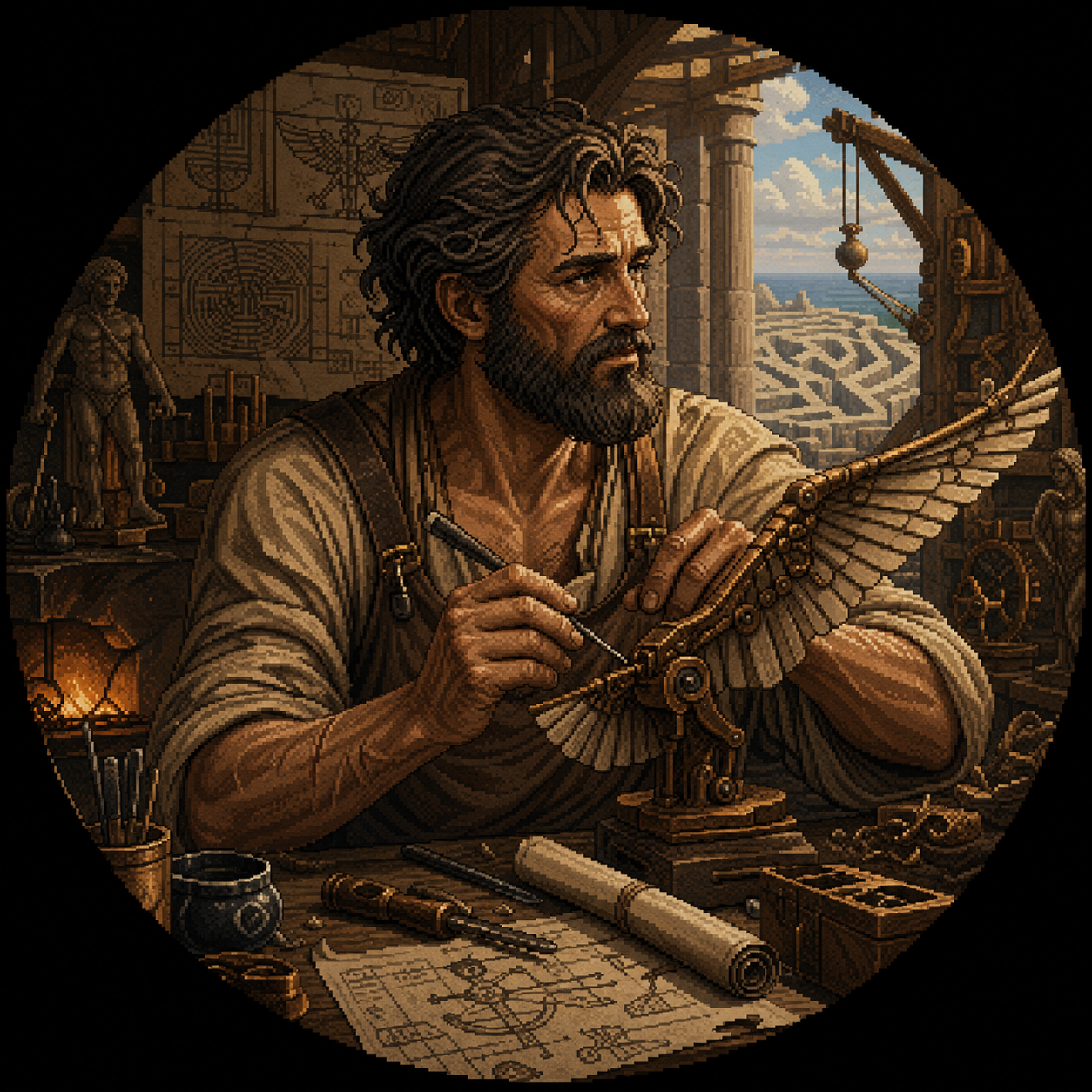
<p><img src="/assets/blog/grokbot-daedalus.png" alt="Daedalus, the master builder: a pixel-art craftsman in an ancient workshop shaping a mechanical wing, a labyrinth visible through the window" /></p>

<p><strong>Daedalus, the master builder.</strong> Architecture, systems design, elegant construction. Daedalus is who I hand a green field to. He designs the labyrinth <em>and</em> the wings to escape it: structure first, then the clever thing that makes it fly.</p>

<p><img src="/assets/blog/grokbot-sherlock.png" alt="Sherlock, the master detective: a pixel-art Victorian sleuth with a pipe at a cluttered Baker Street desk, Big Ben through the window" /></p>

<p>And there’s a bench behind the starters, each one a job I know I’ll eventually want:</p>

<ul>
  <li><strong>Athena</strong>, the strategic commander: judgment, planning, diplomacy, disciplined leadership.</li>
  <li><strong>Neo</strong>, the system breaker: unconventional solutions, hidden patterns, escaping constraints.</li>
  <li><strong>Zeus</strong>, the executive authority: decisive action, delegation, high-stakes calls.</li>
  <li><strong>Newton</strong>, the first-principles thinker: logic, math, rigorous cause-and-effect.</li>
  <li><strong>Leo (Da Vinci)</strong>, the visionary inventor: creativity, design, imaginative problem-solving.</li>
  <li><strong>Loki</strong>, the cunning disruptor: red-teaming, loopholes, challenging every assumption you didn’t know you were making.</li>
</ul>

<p>Loki, for the record, is the one I’d trust to try to break my own code before somebody else does.</p>

<h2 id="the-chief-of-staff">The chief of staff</h2>

<p>Here’s the part I’m most excited about. I don’t actually want to manage ten agents. I want to manage <em>one</em>, and have that one manage the rest.</p>

<p>The org chart is simple: a <strong>chief of staff</strong> agent sits on top. I bring it the goal. It decides which specialist gets which piece, hands out the work, and pulls the results back together. I talk to one agent; a team does the work. That’s the whole dream of a multi-agent setup, and a good harness is what makes it a workflow instead of a party trick.</p>

<p>Two modes fall out of this naturally:</p>

<ul>
  <li><strong>One big project, many hands.</strong> The chief of staff splits a single effort across the crew: Daedalus lays out the architecture, Link scouts the existing code, Ender takes the hard subsystem, Sherlock stands by for when something inevitably breaks.</li>
  <li><strong>Many projects, right specialist each.</strong> Or point the team at <em>separate</em> problems at once, letting the chief of staff match each job to whoever’s built for it.</li>
</ul>

<p>The manager pattern is what keeps it from turning into chaos. Ten agents with no coordination is just ten ways to get confused. One coordinator with ten specialists is a team.</p>

<h2 id="the-multi-model-escape-hatch">The multi-model escape hatch</h2>

<p>There’s a wonderfully practical benefit to a strong harness that has nothing to do with intelligence and everything to do with logistics: <strong>it can manage more than one model.</strong></p>

<p>Run out of tokens on one? Spin up another, reconnect it to your GitHub, and keep going. Between Claude, Codex, Gemini, and Grok, if you carry subscriptions across all four, it’s genuinely hard to get <em>stuck</em>. The harness abstracts the provider away, so “I hit a limit” stops being “I’m done for the day” and becomes “switch lanes and continue.”</p>

<p>The same machinery powers concurrency. Because the harness can assign <strong>different models to different agents</strong>, your chief of staff can run on one model while each specialist runs on whatever suits its role, all at the same time. Different models, different agents, different jobs, one team, running in parallel.</p>

<h2 id="beyond-code-pointing-the-team-at-a-life">Beyond code: pointing the team at a life</h2>

<p>Here’s where it stops being a coding trick and starts being something I actually care about. The same structure, a chief of staff directing focused specialists, works on goals that have nothing to do with software.</p>

<p>I keep a running list of the kind of person I’m trying to be:</p>

<ul>
  <li>A <strong>supportive husband</strong> who actually understands her needs and struggles.</li>
  <li>A <strong>loving father</strong> who backs his kids’ interests and gives them unstructured, unhurried time.</li>
  <li>A <strong>top-notch home caretaker</strong>, the clean garage, the organized closet, the dog-poop-and-appliances stuff that quietly runs a household.</li>
  <li>A <strong>responsible, healthy man</strong>, mobility work, less belly fat, more strength.</li>
</ul>

<p>None of that is a coding task. But all of it is the kind of thing a well-briefed, well-remembered system is good at: holding the goal, breaking it into next actions, and nudging me back on track when I drift. If a harness can keep a coding project’s context alive across sessions, it can keep <em>these</em> alive too. That’s the version of this I’m building toward.</p>

<h2 id="how-does-it-compare-to-openclaw">How does it compare to OpenClaw?</h2>

<p>The obvious question, if you’ve been following this space, is how Grok Bot stacks up against OpenClaw, the open-source harness a lot of tinkerers reach for first.</p>

<p>They’re solving the same problem from opposite ends. OpenClaw is the maximalist, roll-your-own option. It’s open, hackable, and endlessly configurable, which is exactly what you want if you enjoy living in config files and wiring your own orchestration logic. The ceiling is high. So is the setup cost. You own every piece, including the parts that break at 11pm.</p>

<p>Grok Bot trades some of that raw flexibility for a smoother on-ramp. The multi-agent model is a first-class feature rather than something you assemble yourself, personalizing an agent is a built-in idea instead of a convention you invent, and the harness handles the caching and environment consistency for you rather than leaving it as an exercise. You give up a little control and you get back a lot of time.</p>

<p>A few honest distinctions as I see them:</p>

<ul>
  <li><strong>Setup.</strong> OpenClaw expects you to bring the plumbing. Grok Bot ships with more of it already connected.</li>
  <li><strong>Personalization.</strong> Naming and specializing agents is a core Grok Bot workflow. In OpenClaw it’s achievable, but it’s on you to structure.</li>
  <li><strong>Model juggling.</strong> Both can talk to multiple providers. Grok Bot leans into the “run out of tokens, switch lanes, keep going” pattern as an expected way to work rather than a clever hack.</li>
  <li><strong>Who it’s for.</strong> OpenClaw rewards the person who wants to understand and control every layer. Grok Bot rewards the person who wants a team working today.</li>
</ul>

<p>Neither is strictly better. If you want a workshop, OpenClaw hands you the whole workshop. If you want a crew that’s already clocked in, Grok Bot is the faster path. I’ve spent time in both, and lately I reach for the one that lets me think about the work instead of the wiring.</p>

<h2 id="where-is-this-expected-to-go-from-here">Where is this expected to go from here?</h2>

<p>If I had to bet, the next chapter is less about smarter models and more about smarter coordination. A few directions I think are coming, some sooner than others:</p>

<ul>
  <li><strong>The chief of staff gets real autonomy.</strong> Right now I still hand it the goal and watch closely. The near future is a coordinator I trust to break down a fuzzy objective, assign it, check the results, and only surface the decisions that genuinely need me.</li>
  <li><strong>Persistent memory across the whole team.</strong> Today each agent’s context lives mostly in its own lane. The version I want is a shared, durable memory the entire crew reads from, so Sherlock already knows what Daedalus built last week without me repeating it.</li>
  <li><strong>Agents that improve their own guidance.</strong> The <code class="language-plaintext highlighter-rouge">.md</code> files that steer each specialist are hand-written now. It’s a short hop to agents that notice a recurring mistake and propose an edit to their own instructions.</li>
  <li><strong>Blurring the line between coding and life admin.</strong> The same structure that ships software can run a household or a training plan. I expect the “point a team at a personal goal” idea to stop feeling novel and start feeling normal.</li>
  <li><strong>Provider-agnostic by default.</strong> As harnesses mature, which model sits behind which agent should matter about as much as which brand of wrench is in the drawer. You pick the right tool for the job and stop thinking about it.</li>
</ul>

<p>None of this requires a breakthrough. It mostly requires the harness to keep getting better at the unglamorous work of remembering, coordinating, and staying out of the way. That’s the part I’ll be watching.</p>

<h2 id="the-real-takeaway">The real takeaway</h2>

<p>It’s tempting to chase the newest, smartest model. But the leverage isn’t in the model, it’s in the harness around it: the skills it loads, the context it caches, the environment it keeps consistent, and its ability to run a whole team of specialists, across multiple models, toward a goal.</p>

<p>Grok Bot made that team concrete for me, and gave a wizard, a scout, a boy general, an inventor, and a detective somewhere real to live. The characters are a bit of fun. The structure underneath them, one coordinator, many specialists, persistent context, model-agnostic, is the serious part.</p>

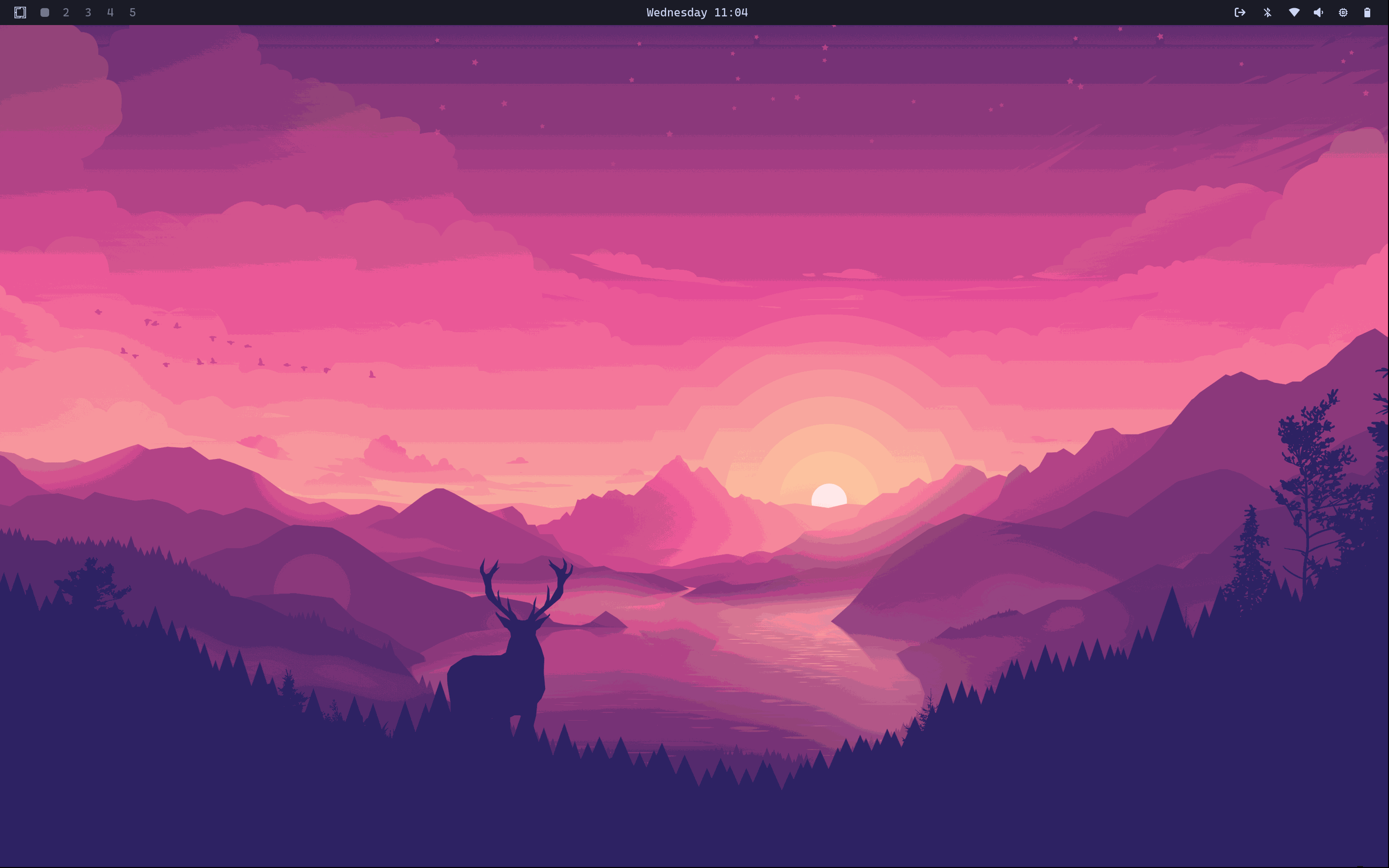
<p>If you’re curious what a setup like this could look like for your own work, or your own life, that’s exactly the kind of thing I love thinking through. Come say hi.</p>]]></content><author><name>⌃click</name></author><summary type="html"><![CDATA[Grok Bot turns a good coding harness into a roster of specialized AI agents you can name, personalize, and point at real work. Here's what a chief-of-staff-and-crew model looks like in practice, and why the harness matters more than any single model.]]></summary></entry><entry><title type="html">I Almost Spent $15,000 to Run AI Locally — So I Revived a 10-Year-Old MacBook Instead</title><link href="https://it.maggio.xyz/blog/omarchy-on-a-ten-year-old-macbook-pro/" rel="alternate" type="text/html" title="I Almost Spent $15,000 to Run AI Locally — So I Revived a 10-Year-Old MacBook Instead" /><published>2026-08-27T08:00:00-07:00</published><updated>2026-08-27T08:00:00-07:00</updated><id>https://it.maggio.xyz/blog/omarchy-on-a-ten-year-old-macbook-pro</id><content type="html" xml:base="https://it.maggio.xyz/blog/omarchy-on-a-ten-year-old-macbook-pro/"><![CDATA[<p><img src="/assets/blog/omarchy-desktop.png" alt="The Omarchy desktop: a minimalist pink-and-purple mountain sunset with a stag, and a tiling window manager's top bar" /></p>

<p>This started with me wanting a new Mac Studio.</p>

<p>By the time I configured the machine I actually wanted, with enough memory and processing
power to run serious AI models locally, the price was somewhere between $10,000 and $15,000.
The appeal was obvious. I could run agents without paying by the token, keep private data on my
own machine, and stop depending on somebody else’s cloud.</p>

<p>Then I did the subscription math.</p>

<p>Claude, ChatGPT, Grok, and Gemini are each roughly a $20-a-month decision at the individual
subscription level. Even if I paid for all four, it would take more than 10 years to spend what
that Mac Studio would cost. The computer might be private and powerful, but it was not going to
make local AI free. It was just going to make me pay a very large bill up front.</p>

<h2 id="a-test-of-the-local-dream">A test of the local dream</h2>

<p>Before spending anything, I tried a smaller experiment on the computer I already use: a MacBook
Pro with an M1 Max processor and 64GB of RAM. That is not a slow computer.</p>

<p>I ran a Qwen 3 8B model locally and said hello. It took about 10 minutes to answer.</p>

<p>Then I asked it to make a single PDF flyer for my business. More than 10 hours later, I had a
flyer. It was not horrible, but it was not usable either. It needed another pass. I could make
those changes in ChatGPT in less than 30 minutes, fix the flyer myself in under an hour, or send
it back through the local model and wait another 10 hours to see what happened.</p>

<p>That was the moment the local-computing dream ran into the present. To get the experience I
wanted, I was going to need massive capital or massive patience. Neither one made much sense
when the frontier models available online are so capable and comparatively inexpensive.</p>

<p>Maybe the privacy part of the dream needs to wait for now.</p>

<h2 id="looking-in-the-other-direction">Looking in the other direction</h2>

<p>Instead of asking how much computer I could buy, I started wondering how much computer I
already had.</p>

<p>There are a few old machines sitting around my office. I have also been hearing for years that
Linux is where much of the interesting AI development happens. What always stopped me was the
usual Linux tax: driver problems, configuration rabbit holes, and an afternoon disappearing
because one small piece of hardware would not cooperate.</p>

<p>The newer AI-first distributions made me wonder if that had changed. After watching DHH’s video
about Omarchy and his interview with Lex Fridman, I decided to try it on a 2016 MacBook Pro. The
machine has a 2.3GHz dual-core Intel i5 and only 8GB of RAM. In 2026, it is about as far from a
maxed-out Mac Studio as I could get.</p>

<p>It took seven minutes to flash the Omarchy installer onto a thumb drive. Then it took another
five minutes for me to remember how to bring up the Mac’s boot selection screen.</p>

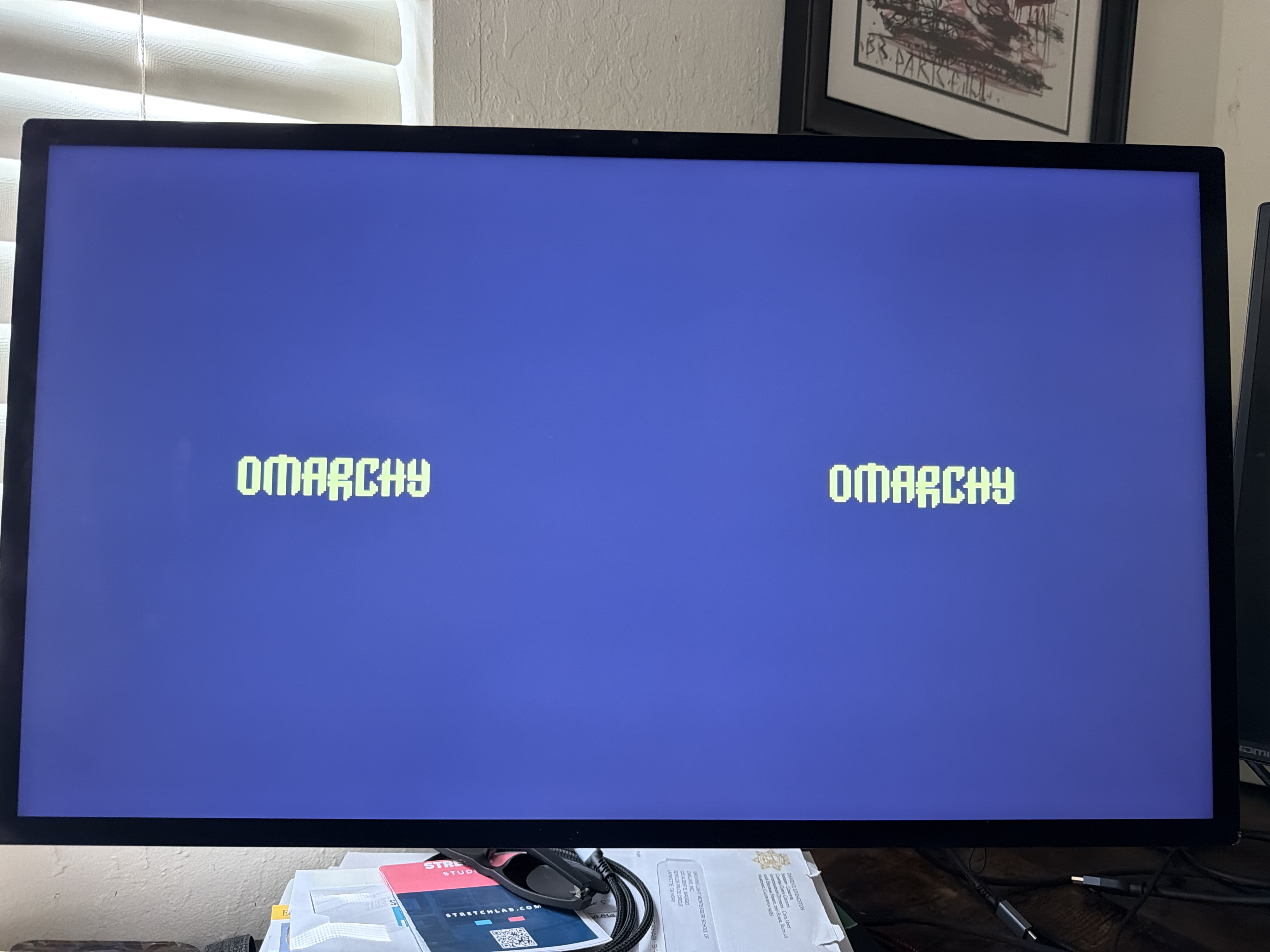
<p>My first attempt went nowhere. The boot image appeared, but the process never progressed. It
turned out I had plugged the thumb drive into a secondary monitor instead of directly into the
MacBook. I moved it to the computer, restarted, and tried again.</p>

<p><img src="/assets/blog/omarchy-boot-hang.jpg" alt="The Omarchy boot screen stalled on the external monitor, the logo frozen instead of progressing" /></p>

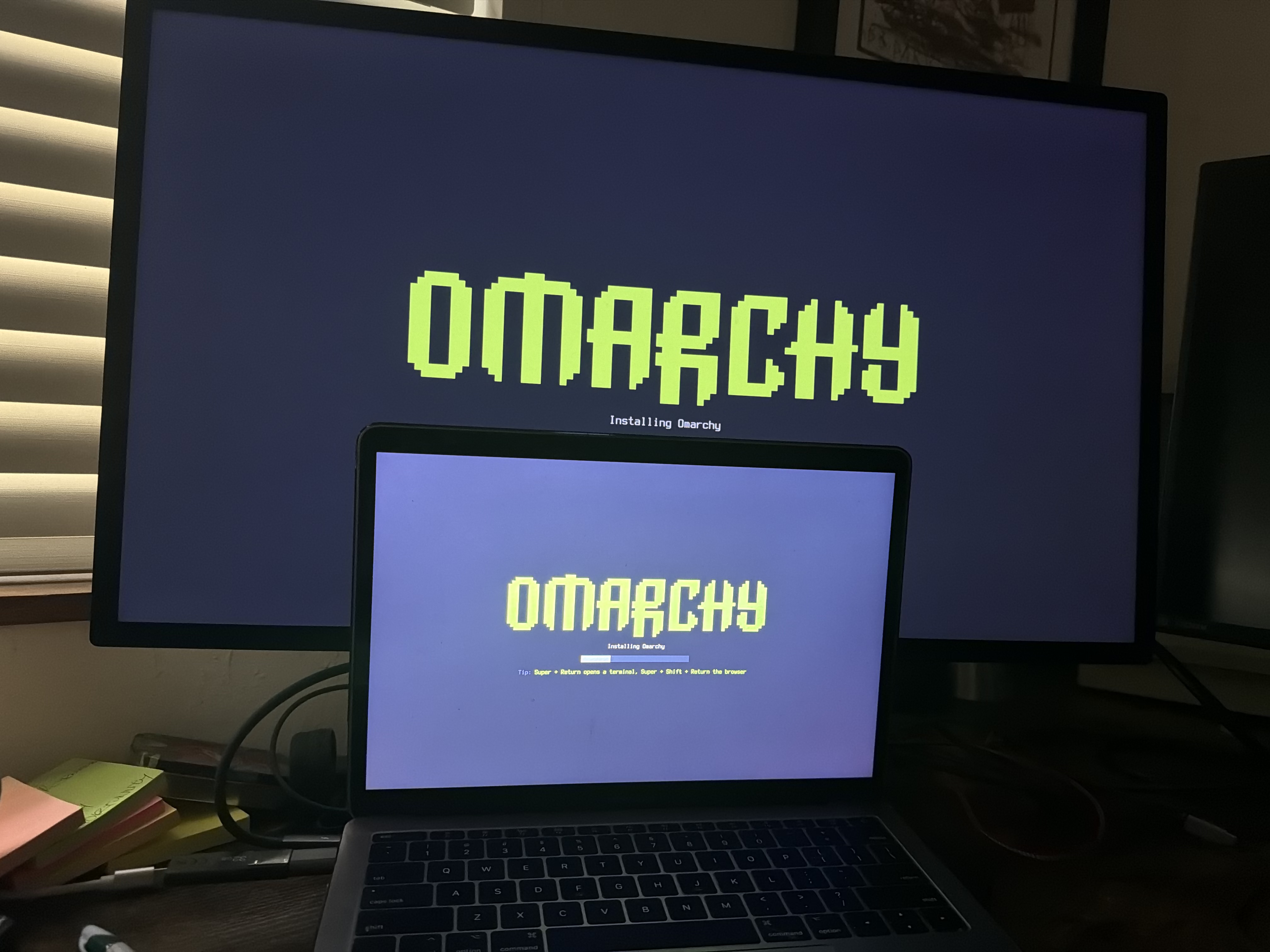
<p>This time Omarchy installed in 3 minutes and 42 seconds. I was logged in and using the system in
under five minutes.</p>

<p><img src="/assets/blog/omarchy-installing.jpg" alt="Omarchy installing, the progress bar running across both the MacBook's own screen and the external monitor" /></p>

<p>That was amazing.</p>

<h2 id="the-old-computer-felt-new-again">The old computer felt new again</h2>

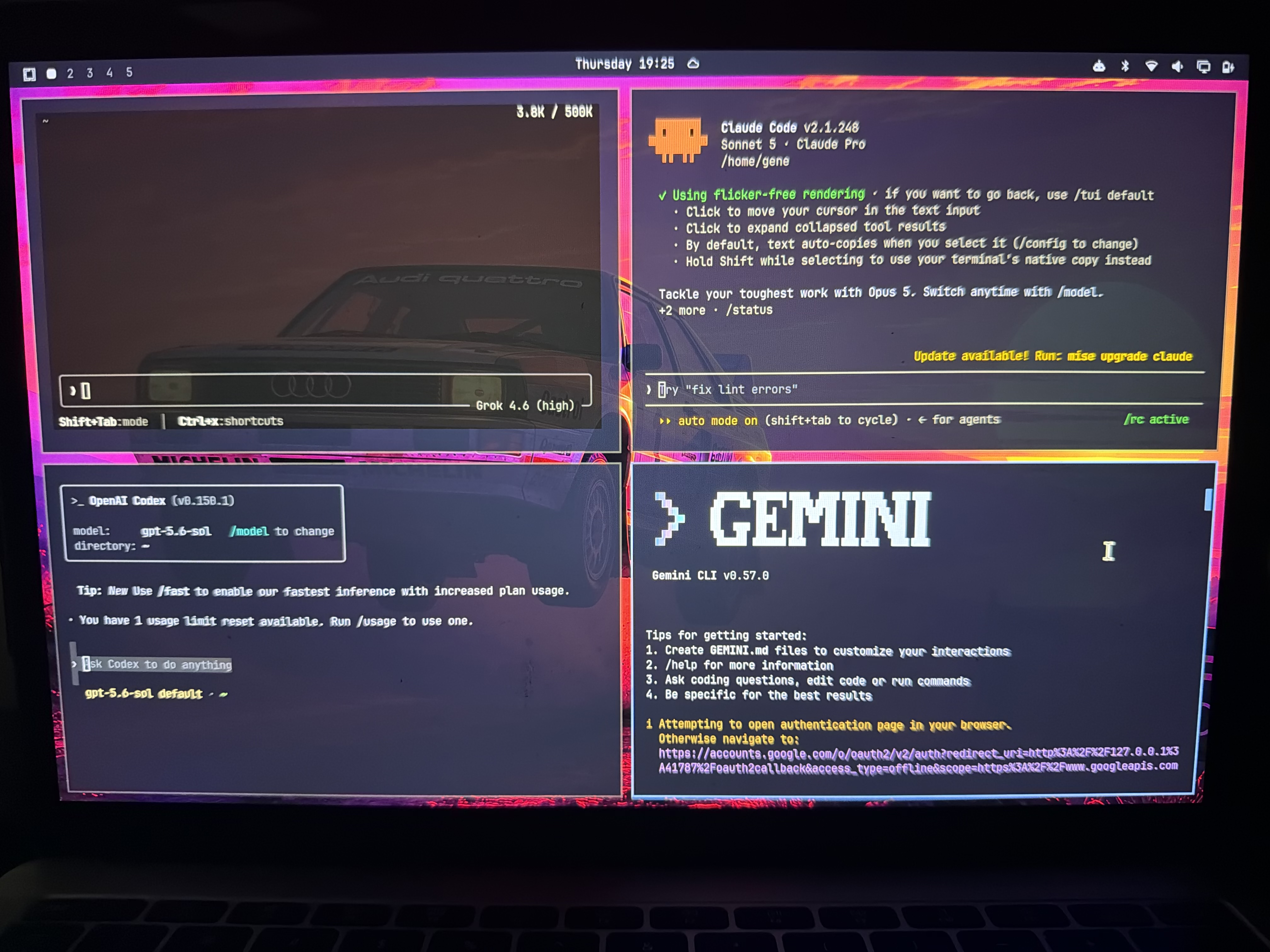
<p>After getting used to the weight of macOS and Windows, Omarchy felt incredibly fast. Browser
tabs flew. Terminal windows popped open instantly. Before long, I had all four frontier models
working on tasks through their web interfaces while I moved around the rest of the system.</p>

<p><img src="/assets/blog/omarchy-four-models.jpg" alt="Four AI coding CLIs tiled on the Omarchy desktop at once: Claude Code, OpenAI Codex, Gemini, and Grok" /></p>

<p>The little Intel MacBook handled 4K video on YouTube while I kept other browser tabs and terminal
windows open. For ordinary daily work, it often felt faster than my current computer. Not faster
at local inference, of course, but faster at the work I was actually doing.</p>

<p>Then I found the first very Linux problem: there was no sound.</p>

<p>This model of MacBook uses proprietary speaker hardware that needed some additional support. In
the Linux I remember, that discovery would have meant searching old forum threads, comparing
commands written for three different distributions, and hoping I did not make things worse.</p>

<p>This time I opened a terminal with Claude Code and asked what to do. It gave me the steps. I
copied them into another terminal, restarted the machine, and the speakers worked. The sound is
not perfect, but it works.</p>

<p>That small experience felt like a much bigger change. AI does not magically eliminate hardware
problems, but it removes a lot of the fiddliness that used to make Linux difficult to recommend.
I did not need to know the right package name or where a configuration file lived before I
started. I could describe the problem in plain English and work through it from there.</p>

<p>I had the same experience with window management. Omarchy’s defaults did not quite fit the way I
like to use full-screen apps and spaces. I asked Claude Code to help me change the behavior, and
now it works the way I want.</p>

<p>Two problems that might once have ended the experiment became minor setup tasks.</p>

<h2 id="what-is-still-missing">What is still missing</h2>

<p>The biggest break from the Mac is not performance. It is the Apple ecosystem.</p>

<p>There is no native iCloud integration, so my passwords, iMessages, and files do not simply appear
when I sign in. I can find other tools and build workarounds, but none of it is as seamless as
opening a new Mac and having everything waiting for me. That is the clearest pain point so far,
and it may keep this machine from becoming my only computer.</p>

<p>It does not stop the MacBook from being useful, though. A computer that had aged out of my normal
workflow is suddenly a fast, focused machine for browsing, writing, terminal work, and using AI
services. Instead of spending five figures to force frontier-scale AI onto my desk, I put a free
operating system on hardware I already owned and used the best online models from there.</p>

<h2 id="my-first-day-verdict">My first-day verdict</h2>

<p>This was my first real experience with Omarchy, my first time using a modern Linux distribution
as a daily computer, and my first time running Linux on a Mac. I expected the install to be the
beginning of a project. Instead, the whole machine was ready in minutes.</p>

<p>I am not pretending an eight-gigabyte Intel MacBook can replace a new Mac Studio for every job.
It cannot. It is also not the private local-agent machine I originally imagined. For now, the
actual AI work is still happening on someone else’s powerful computers.</p>

<p>But the experiment changed the question. I started by asking whether I needed a $15,000 machine
to take advantage of AI. I ended up asking how AI could help me get more life out of the
computers I already have.</p>

<p>One day in, Omarchy has made a 10-year-old MacBook Pro feel useful again. That is a much less
expensive answer, and a more interesting one than I expected.</p>]]></content><author><name>⌃click</name></author><summary type="html"><![CDATA[A new Mac Studio sent me looking at local AI. A very slow experiment sent me in the other direction: putting Omarchy on a 2016 Intel MacBook Pro with 8GB of RAM and seeing how useful an old computer could become.]]></summary></entry><entry><title type="html">One Life, Written Down Once: Building a Personal AI Operating System (Wiki, Not RAG)</title><link href="https://it.maggio.xyz/blog/one-life-written-down-once/" rel="alternate" type="text/html" title="One Life, Written Down Once: Building a Personal AI Operating System (Wiki, Not RAG)" /><published>2026-08-17T12:00:00-07:00</published><updated>2026-08-17T12:00:00-07:00</updated><id>https://it.maggio.xyz/blog/one-life-written-down-once</id><content type="html" xml:base="https://it.maggio.xyz/blog/one-life-written-down-once/"><![CDATA[<p>For the last few months I’ve been building a thing I call <strong>Life-Journal</strong>. It isn’t a
product, and it isn’t for sale. It’s a personal operating system for one person, me,
trying to live one integrated life across a lot of different realms: husband, father, the
family I come from, friends, the house, the community, the business, my coaching practice,
the technologist who can’t help but build things, and the self underneath all of it.</p>

<p>The premise was simple and a little stubborn. I write. I already keep a journal. What I
wanted was for that writing to <em>do something</em>, to quietly keep the rest of my life
organized without me having to say the unnecessary parts twice. As I put it to Claude early
in the design conversations:</p>

<blockquote>
  <p>“My goal is to be as integrated in my life as possible. Every realm potentially overlaps
with another one, and I’m relying on this system to unify my awareness and efforts across
each realm and each day.”</p>
</blockquote>

<p>This post is about how that got built, what I learned, and where it’s going, and the
decision at the center of it that I most enjoyed thinking through:
<strong>I chose a wiki over RAG.</strong> More on that below, because it’s the part I had the most fun with.</p>

<p><em>Updated 2026-08-03: there’s now a <strong>v2</strong>, and it changed what the system is for rather than what
it does. <a href="#v2-what-am-i-not-seeing-yet">Skip to it</a> if you’ve read this before.</em></p>

<hr />

<h2 id="the-shape-of-the-thing">The shape of the thing</h2>

<p>Here’s the whole system in one picture. It’s worth a slow look, because almost every idea in
this post is somewhere on it.</p>

<p><img src="/assets/blog/lifejournal-architecture.svg" alt="Life-Journal system architecture" /></p>

<p>Three properties are worth calling out before anything else, because they’re the spine:</p>

<ol>
  <li>
    <p><strong>The git repo is the only datastore.</strong> Every fact in my life-system is a file (Markdown,
YAML, JSON) versioned in git. There’s no database. There’s no vendor to outlive. The
assistant’s entire edit history is <code class="language-plaintext highlighter-rouge">git log</code>. If Anthropic vanished tomorrow, or Vercel
did, or I got bored of the whole thing, I’d still have a folder of readable text files
that make complete sense on their own.</p>
  </li>
  <li>
    <p><strong>Derivation is pure and computed at read time.</strong> Due dates, trends, gaps, the day’s
agenda, each realm’s summary, none of it is stored. It’s all computed from the files when
a page loads. A stored status goes stale silently the day after you write it. A computed
one can’t.</p>
  </li>
  <li>
    <p><strong>Every write into the store is governed.</strong> The daily pipeline writes through validated
operations with ownership enforcement. The app writes through GitHub’s Contents API with
compare-and-swap. I can write anything, anywhere. Nothing else writes at all.</p>
  </li>
</ol>

<p>The daily rhythm is a scheduled job. Around 4:30 in the morning a GitHub Action wakes up,
applies any structural changes I approved the day before, fetches my calendars, ingests
whatever I journaled, hands each entry to a model with the full context of my life, gets back
a list of <em>operations</em>, applies them under strict ownership rules, regenerates the “Today”
view, runs 31 validation check groups, and commits. On Sundays a second job reads the whole
week at once and writes a synthesis, a coach’s read on how the week actually went.</p>

<p>The models are tiered to the weight of the job: a cheap model classifies calendar titles
(cached forever, so a weekly meeting is forty events and <em>one</em> classification), a mid-tier
model turns journal entries into operations, and the highest-judgment model in the house does
the Sunday synthesis. It’s a cost architecture as much as a quality one.</p>

<hr />

<h2 id="the-two-axes">The two axes</h2>

<p>The brief was a grid: <em>“each realm and each day.”</em> So the architecture took that literally.
There are two orthogonal ways to read the same underlying files:</p>

<ul>
  <li><strong>The day axis</strong> (<code class="language-plaintext highlighter-rouge">agenda.ts</code>) answers <em>“What is asking for me today?”</em>: overdue things,
today’s things, this week, the focus list, and the standing commitments, pulled from
projects, the house, the trust, the calendar, and the seasons of the year.</li>
  <li><strong>The role axis</strong> (<code class="language-plaintext highlighter-rouge">realm.ts</code>) answers <em>“What is the state of this realm?”</em>: work, people,
events, goals, trends, and gaps, assembled the same way for every realm so they all read
alike.</li>
</ul>

<p>Because both read the same modules, the daily view, the realm page, and the Sunday review
<em>cannot disagree with each other.</em> And the day axis computes something I’ve come to love:
<strong>convergences</strong>, a piece of work filed to two roles at once, a date where several realms
land together, a season declaring a role important while nothing is queued against it. They’re
always computed from data, never inferred, because a fabricated connection in a system built
to unify awareness is worse than no connection at all.</p>

<p>That last sentence turned out to be a design principle I’d reuse over and over.</p>

<hr />

<h2 id="the-fork-i-found-most-fascinating-a-wiki-not-rag">The fork I found most fascinating: a wiki, not RAG</h2>

<p>Here’s the fork in the road. When you build a system that reads your life and needs to
“remember” it, there are broadly two ways to give a language model that memory.</p>

<p><strong>The RAG way</strong>: retrieval-augmented generation. You take everything (every journal entry,
every fact, every note), embed it into a vector database, and at generation time you retrieve
the handful of chunks most semantically similar to whatever you’re currently working on, and
feed those to the model. The memory is one big undifferentiated corpus plus a similarity
search. Nothing is curated. The structure, such as it is, emerges at query time.</p>

<p><strong>The wiki way</strong>: the one I chose. The raw journal stays sacred and verbatim, but the
<em>signal</em> in it gets continuously curated into structured, human-readable pages: one wiki per
realm, typed data stores for money and the house, dashboards for interpretation. The memory
isn’t a corpus you search, it’s an institutional memory you can <em>read</em>. When the model needs
context, you hand it the relevant curated pages, not the nearest embeddings.</p>

<p>I want to be honest about why I picked the wiki, because it wasn’t purely a performance call.</p>

<p><strong>I picked it partly because I wanted to learn it.</strong> Building a curation layer (deciding what
signal routes where, how a realm page assembles itself, how a fact becomes a wiki line with
provenance attached) is a genuinely harder and more interesting problem than standing up a
vector store and calling <code class="language-plaintext highlighter-rouge">retrieve()</code>. I wanted to build the harder thing. I wanted to
understand, in my hands, what it takes to turn a stream of writing into an organized,
self-maintaining knowledge base. That’s a builder’s reason, not an architect’s, and I’m not
going to pretend otherwise.</p>

<p><strong>And I picked it because I wanted it to be human-readable.</strong> This is the reason I’d actually
defend to a stranger. A vector database is not something you can open and understand. It’s
opaque by construction. But the entire point of this system is captured in its tagline: <em>one
life, written down once, read many ways.</em> If the memory of my own life is a black box I can’t
inspect, edit, or trust, I’ve missed the point. With a wiki I can open any page and see my
life at a glance. I can correct it. I can watch it fill in, and I can watch it <em>fail</em> to fill
in, which turns out to matter. The <code class="language-plaintext highlighter-rouge">friends</code> realm started completely empty, and that
emptiness was itself the finding: nothing in my journal had ever referred to a friendship. A
vector store would have hidden that. A blank wiki page couldn’t.</p>

<p>Let me lay the tradeoff out plainly, because it’s a real one:</p>

<table>
  <thead>
    <tr>
      <th> </th>
      <th><strong>Wiki (what I chose)</strong></th>
      <th><strong>RAG / vector store</strong></th>
    </tr>
  </thead>
  <tbody>
    <tr>
      <td><strong>Legibility</strong></td>
      <td>You can read, browse, and audit the whole memory</td>
      <td>Opaque; you can’t read a vector</td>
    </tr>
    <tr>
      <td><strong>Editability</strong></td>
      <td>Human-owned; I correct facts directly</td>
      <td>You’d re-embed; no clean ownership model</td>
    </tr>
    <tr>
      <td><strong>Provenance</strong></td>
      <td>Every assistant line is stamped <code class="language-plaintext highlighter-rouge">(journal:YYYY-MM-DD)</code></td>
      <td>Retrieved chunks, weakly attributed</td>
    </tr>
    <tr>
      <td><strong>Surfacing gaps</strong></td>
      <td>An empty page <em>is</em> a signal</td>
      <td>Absence is invisible</td>
    </tr>
    <tr>
      <td><strong>Infra</strong></td>
      <td>Text files in git; nothing to maintain</td>
      <td>A vector DB, embeddings that drift with model changes</td>
    </tr>
    <tr>
      <td><strong>Curation</strong></td>
      <td>Lossy; a fact routed nowhere is invisible</td>
      <td>Nothing is discarded; everything is retrievable</td>
    </tr>
    <tr>
      <td><strong>Scaling</strong></td>
      <td>Pages grow; you still hit context limits eventually</td>
      <td>Retrieval was <em>designed</em> for the context-limit problem</td>
    </tr>
    <tr>
      <td><strong>Structure</strong></td>
      <td>Rigid taxonomy; cross-cutting facts are awkward</td>
      <td>No taxonomy to get wrong</td>
    </tr>
    <tr>
      <td><strong>Recall</strong></td>
      <td>Keyword/structured lookup</td>
      <td>Semantic recall can find non-obvious connections</td>
    </tr>
  </tbody>
</table>

<p>Look at the two halves of that table and you’ll see what makes this fork so interesting: <strong>the
wiki’s strengths and RAG’s strengths sit on opposite sides.</strong> Curation is lossy: every routing
decision decides where a fact will, or won’t, be found later. And the wiki doesn’t escape the
context-window problem so much as defer it: as my life accumulates, I can’t hand the whole wiki
to a model any more than I could hand it the whole corpus, so at some point you <em>retrieve</em> the
relevant subset anyway, and structured retrieval over human-readable pages is, if you squint,
RAG wearing friendlier clothes. Which is exactly why the two feel less like rivals and more like
two ends of the same idea.</p>

<p>This is the part of the experiment I’m most curious about. A few months in, the legibility has
already delighted me more than once: opening my own life-memory to read it, edit it, and notice
its holes is exactly the experience I set out to build. And the open question, what happens at
a few thousand entries, is the fun kind. My hunch is that the answer becomes <em>both</em>: a curated
wiki for the parts a human wants to read, and retrieval underneath for the parts a model needs
to find. Discovering which, by living in it, is the whole point.</p>

<hr />

<h2 id="what-i-learned-building-it">What I learned building it</h2>

<p>A few things surprised me enough to write down.</p>

<p><strong>“Never invent a fact” is a whole architecture, not a rule.</strong> The most load-bearing decision
in the system is that the assistant never fabricates. Unknowns stay as a visible <code class="language-plaintext highlighter-rouge">⟨CONFIRM⟩</code>
placeholder; money is tracked in integer cents and <code class="language-plaintext highlighter-rouge">null</code> never quietly becomes zero;
approximations (“a couple grand”) are never hardened into figures. This sounds like a policy,
but it turned into schemas, validators, prompt contracts, and tests, because the whole thing
only works if I <em>trust it enough to journal honestly.</em> The moment it invents something, I stop
telling it the truth, and then it has nothing real to organize.</p>

<p><strong>Computed beats stored, almost always.</strong> Every time I was tempted to cache a status, it would
have gone stale. Keeping derivation pure (no I/O, no clock, fully tested functions that
recompute on every read) is more work up front and eliminates an entire category of bug where
the displayed state quietly diverges from reality.</p>

<p><strong>Proposals are the pressure-release valve.</strong> The assistant can fill in a blank, but it can’t
<em>restructure</em>: it can’t add a realm, rename a payee, or create a goal on its own. Those come
back to me as proposals I accept or decline. That single boundary is what lets the automation
be aggressive about the small stuff without ever running away with the big stuff.</p>

<p><strong>The calendar taught me the value of refusing features.</strong> The system deliberately has <em>no</em>
plan-versus-actual view, because a calendar feed records what was <em>scheduled</em>, not what
<em>happened</em>: a cancelled meeting and one that ran three hours are identical in the file.
Building that comparison would mean inventing a distinction the data can’t support. Half of
good design here was choosing what <em>not</em> to build.</p>

<hr />

<h2 id="v2-what-am-i-not-seeing-yet">v2: “What am I not seeing yet?”</h2>

<p><em>Added August 2026.</em></p>

<p>Everything above describes a system that was working. Entries came in, the wiki stayed current,
the plate told me what the day wanted. It did what I asked.</p>

<p>And then I noticed I’d asked for the wrong thing.</p>

<p>What I had built was a very good filing system with a coach bolted on. Every morning it answered
<strong>“what should I do?”</strong>, competently, with real data behind it. But the question I actually
wanted answered, the one that made me start this in the first place, was different:</p>

<blockquote>
  <p><strong>What am I not seeing yet?</strong></p>
</blockquote>

<p>Those are not the same question, and a system optimized for the first will never accidentally
answer the second. Filing is about retrieval. Awareness is about synthesis. I had built the
former and been quietly disappointed it wasn’t doing the latter.</p>

<h3 id="what-was-actually-missing">What was actually missing</h3>

<p>I wrote up three long documents trying to describe the gap, handed them to Claude alongside the
running codebase, and asked it to reconcile them rather than pick a side. The most useful thing
that came back wasn’t a plan, it was a diagnosis:</p>

<blockquote>
  <p>This is not a failed architecture. It is a strong operating architecture whose deeper product
meaning is distributed across prompts, prose, and reports rather than represented explicitly.</p>
</blockquote>

<p>That landed. The system <em>knew</em> things about me. It just had no way to say <strong>how</strong> it knew them,
how sure it was, or what would change its mind. Every insight was a sentence in a report. There
was no difference, structurally, between something I had told it and something it had inferred,
and that difference is the whole ballgame when the subject is a person.</p>

<p>So v2 didn’t replace anything. It added the layer underneath: evidence, claims with an origin,
confidence that means something, a slow-changing model of identity, and a concept I’d been
circling for months without a name.</p>

<h3 id="the-next-adjacent">The Next Adjacent</h3>

<p>Borrowed from Kevin Kelly’s <em>adjacent possible</em>, and it’s the idea the whole thing now organizes
around. Growth isn’t a climb toward a finished version of yourself. Every experience unlocks
possibilities that couldn’t be seen from where you were standing before. So the question is never
“how do I reach the end state”, it’s <strong>what has just become reachable?</strong></p>

<p>Which gave me the loop the system now runs on:</p>

<div class="language-plaintext highlighter-rouge"><div class="highlight"><pre class="highlight"><code>Identity  →  Awareness  →  Next Adjacent  →  Experience  →  Identity
</code></pre></div></div>

<p>Who am I becoming; what’s true right now; what’s the smallest meaningful step; what actually
happened; and around again, slowly.</p>

<h3 id="the-parts-id-defend-in-an-argument">The parts I’d defend in an argument</h3>

<p><strong>Almost all of it is refusals.</strong> The Next Adjacent generator surfaces <em>at most one</em> possibility a
week, and most weeks none. That’s not a limitation, it’s the feature. A system that finds
something insightful to say every single week has taught you to stop reading it.</p>

<p><strong>Nothing the system infers about me can ever become “confirmed.”</strong> That level requires me to say
it. No amount of accumulated evidence promotes an inference into a declaration, because that’s
the difference between a system that understands you and one that decides who you are.</p>

<p><strong>Identity moves at the speed of seasons.</strong> One journal entry produces a signal, never a
conclusion. Six observations inside a single week reach only “some evidence”, a durable read
needs evidence spanning about two months. An intense fortnight is not a personality.</p>

<p><strong>Four different things get called “a contradiction,”</strong> and only one is mine to resolve. If I
loved coaching in 2024 and I’m worn out by it now, that isn’t an inconsistency, it’s a life
moving. Reading a trajectory as a contradiction would tell me my life doesn’t add up when it’s
merely alive. The system sorts those apart before it ever brings me one.</p>

<p><strong>A declined question is not a rejected patch.</strong> Declining to answer something today says nothing
about whether it was worth asking. Declining an <em>opportunity</em>, though, is a real judgement, and
that one the system should learn from. Different acts, different consequences, and collapsing
them would have been the easy mistake.</p>

<h3 id="the-thing-i-got-wrong-and-what-it-taught-me">The thing I got wrong, and what it taught me</h3>

<p>Early on I asked why the system was so timid, why every gap sat there as a placeholder waiting
for me to fill it in, when the whole point was that it should be synthesizing.</p>

<p>The answer turned out to be a conflation I’d built in without noticing. Two completely different
kinds of blank were wearing the same marker. <em>What’s my wife’s dress size</em>, no amount of
reflection produces that; asking is the only honest move. <em>What does growth mean in this part of
my life</em>, the system has months of my own writing bearing on that, and leaving it blank isn’t
caution, it’s refusing to do the job.</p>

<p>So the rule now is: <strong>never ask me a question the system could answer and let me correct.</strong> An
inferable gap arrives as a candidate with its evidence attached, not a blank.</p>

<p>That has a cost I accepted deliberately: the system records what it infers about me <em>without</em>
asking first, which means a wrong read can sit there unnoticed until I look. The trade only works
because correcting one has to be trivial: one button, and “that’s just not true of me” is a
complete answer requiring nothing else. And a correction sticks to the <em>topic</em>, not the sentence,
so the same wrong idea can’t come back next week wearing different words.</p>

<h3 id="what-v2-taught-me-about-building-with-ai">What v2 taught me about building with AI</h3>

<p>The most valuable thing Claude did across this wasn’t writing code. It was <strong>refusing to build
the thing I asked for until the thing underneath was defined.</strong> Twice it stopped and said, in
effect: you’ve asked me to store this, but deriving it first will tell us what the store needs to
hold. Both times that was right, and both times deriving first immediately surfaced a bug in my
thinking rather than in the code.</p>

<p>The second lesson is that <strong>the guardrails are the product.</strong> Most of what v2 added isn’t
capability, it’s restraint, expressed as code rather than good intentions. Thresholds that can’t
be bypassed. A schema with no field for a character verdict, so one can’t be written. A
contradiction type that offers three answers because two would force a winner. It’s much easier
to write “the system should be careful about X” in a design document than to make X structurally
impossible, and only one of those survives contact with a Tuesday.</p>

<p><em>v2 is running. The first weekly synthesis under the new model hasn’t happened yet, and I expect
the first identity read to be thin, mostly “not enough to say.” Which is, I think, exactly what
it should say.</em></p>

<hr />

<h2 id="where-its-going">Where it’s going</h2>

<p>The current system runs in the cloud: entries pass through Notion, the pipeline runs on GitHub
Actions, and the reasoning happens through the Claude API. The next chapter I’m sketching is a
<strong>native, on-device app</strong>: capture by voice through Siri, transcription on-device, and the
journal-to-operations routing done by an on-device model, with the data synced privately
through iCloud rather than sitting on third-party servers.</p>

<p>And here’s the delightful part, the reason I opened this whole post with the wiki-versus-RAG
question: <strong>the migration brings that decision back around.</strong> An on-device model has a context
window a fraction the size of a frontier model’s. You can’t hand it the full picture the way the
cloud pipeline does today. You fetch only the realms and records a given entry plausibly touches,
which is to say, <em>you retrieve.</em> The wiki and retrieval, which looked like a fork, turn out to
want to live together.</p>

<p>So the idea comes full circle, and I love where it lands. It was never really “wiki <em>or</em> RAG.” It
was “which one <em>first</em>, and where does the other one live.” What I’m excited to build next is the
wiki staying the human-readable heart of the thing, with retrieval growing up underneath it as
the plumbing that lets a smaller model reach into a larger life. Human-legible on top;
machine-efficient below. I didn’t have to choose between them, I just got to choose which one to
build by hand first, and I’m glad it was the one I can read.</p>

<p>There’s a second idea I’m having fun chasing in the native version, and it’s the same instinct in
different clothes. Today my life-memory is legible because it’s <em>files I can read.</em> On-device, I
want to push that one step further, out into the apps I already live in. A dedicated “Life
Journal” folder in Apple Notes, a “Life Journal” list in Reminders, my calendar: let <em>those</em> be
the raw repositories, and let the app be the lens that reads them, files them into spheres, and
surfaces them in context. Tick a task off in Reminders and it closes in the app; jot something in
the folder and it turns up as journal signal. I love the idea of the app <em>cooperating</em> with the
operating system instead of becoming one more place I have to keep in step.</p>

<p>The rule of thumb I’ve landed on is <em>source of truth by layer</em>: let the system apps own the raw,
human-owned input (a note, a reminder, an event) and let the app’s own store own everything
curated and structured, the wiki and the ledgers and the filing, because that’s where ownership
and provenance live. Raw stays accessible and portable; curated stays legible and mine. It’s the
same thread running through the whole project: keep the thing readable and yours, and hand the
machine only the parts it’s genuinely better at.</p>

<p><em>More soon, once the on-device version is real enough to play with.</em></p>

<hr />

<p><em>Life-Journal is a personal project: a single-user system, private by design, not a product.
This post is part of an occasional Ctrl-Click series on building software that’s small,
legible, and yours.</em></p>]]></content><author><name>⌃click</name></author><summary type="html"><![CDATA[Building a personal operating system with Claude, a curiosity-driven experiment, and the fork in the road that made it fascinating: I chose a wiki over RAG, and here is why.]]></summary></entry><entry><title type="html">How to Move Your Business Email Without Losing a Single Message</title><link href="https://it.maggio.xyz/blog/email-migration-without-losing-a-single-message/" rel="alternate" type="text/html" title="How to Move Your Business Email Without Losing a Single Message" /><published>2026-07-13T00:00:00-07:00</published><updated>2026-07-13T00:00:00-07:00</updated><id>https://it.maggio.xyz/blog/email-migration-without-losing-a-single-message</id><content type="html" xml:base="https://it.maggio.xyz/blog/email-migration-without-losing-a-single-message/"><![CDATA[<p>Email migrations have a reputation problem. Ask a business owner about the last time their company changed email providers and you’ll usually hear a story involving lost messages, a weekend of downtime, or a consultant who disappeared halfway through. It doesn’t have to be that way. A migration done right is boring: mail keeps flowing, history comes along, and nobody notices until they log in somewhere new.</p>

<p>Here’s the approach I use when moving businesses between Google Workspace, Microsoft 365, and legacy hosts. It’s less about tools and more about sequence.</p>

<h2 id="audit-before-you-touch-anything">Audit before you touch anything</h2>

<p>Most migration disasters start with an incomplete picture of the current setup. Before any data moves, map out:</p>

<ul>
  <li><strong>Every domain that receives mail</strong>, including the old ones people forgot about that still forward somewhere.</li>
  <li><strong>Every mailbox, alias, and group</strong>, and who actually uses them. Most businesses discover mailboxes nobody has opened in years.</li>
  <li><strong>Forwarding rules and integrations</strong>: the CRM that BCCs itself into deals, the scanner that emails PDFs, the billing system that sends receipts from your domain.</li>
  <li><strong>Current DNS records</strong>: MX, SPF, DKIM, DMARC. Screenshot everything before changing anything.</li>
</ul>

<p>The audit usually takes longer than the migration itself. That’s the point.</p>

<h2 id="stage-the-cutover-never-flip-everything-at-once">Stage the cutover: never flip everything at once</h2>

<p>The safest migration runs both systems in parallel for a window:</p>

<ol>
  <li><strong>Provision the new environment first.</strong> Create every mailbox, alias, and group in the destination before any DNS changes. Verify logins work.</li>
  <li><strong>Sync historical mail early.</strong> Bulk-copy old mail days before cutover, then run a delta sync at the end. This turns the risky part of the migration into a non-event.</li>
  <li><strong>Move MX records with a low TTL.</strong> Drop your DNS TTL to 5 minutes a day ahead, so the cutover propagates fast, and so a rollback would too.</li>
  <li><strong>Keep the old system readable for 30 days.</strong> Don’t cancel the old provider on day one. If anything was missed, it’s still there.</li>
</ol>

<h2 id="authentication-is-not-optional">Authentication is not optional</h2>

<p>A migration is the best moment to fix deliverability, because you’re already in the DNS. Three records determine whether your mail lands in inboxes or spam folders:</p>

<ul>
  <li><strong>SPF</strong>: lists which servers may send as your domain. One record, no more than 10 DNS lookups.</li>
  <li><strong>DKIM</strong>: cryptographically signs your outgoing mail. Enable it in the new provider before cutover, not after.</li>
  <li><strong>DMARC</strong>: tells receiving servers what to do with mail that fails the other two, and sends you reports about who’s sending as your domain. Start with <code class="language-plaintext highlighter-rouge">p=none</code> and monitor before enforcing.</li>
</ul>

<p>If your business skips this step, your first week on the new system will be spent asking clients to check their spam folders.</p>

<h2 id="verify-like-you-dont-trust-yourself">Verify like you don’t trust yourself</h2>

<p>After cutover, confirm the boring things explicitly:</p>

<ul>
  <li>Send and receive a test message on <strong>every</strong> mailbox, not just the owner’s.</li>
  <li>Check that aliases and groups deliver.</li>
  <li>Confirm the scanner, the CRM, the invoicing tool, and every other machine that sends mail still works. These break silently.</li>
  <li>Search the migrated history for the oldest message and a known attachment. If both are there, the sync did its job.</li>
</ul>

<h2 id="when-to-bring-someone-in">When to bring someone in</h2>

<p>If your business has one domain and three mailboxes, you can likely follow the provider’s own migration guide and do fine. Bring in help when there are multiple domains, years of history, compliance requirements, or machines sending mail on your behalf. The failure modes multiply, and the fix for a botched migration costs more than doing it carefully once.</p>

<p>That’s what I do at Ctrl+Click: staged cutovers with rollback plans, full data preservation, and post-migration verification, for businesses around the Bay Area and remotely. If a migration is on your horizon, <a href="https://calendar.app.google/QtYaUwA72XbuKN468">schedule a discussion</a> and we’ll map out your audit together.</p>

<p>Control-click on your email setup: there are more options in there than you think.</p>]]></content><author><name>⌃click</name></author><summary type="html"><![CDATA[A calm, staged approach to email migration, the checklist I use to move businesses between Google Workspace, Microsoft 365, and legacy hosts with zero data loss and no missed mail.]]></summary></entry><entry><title type="html">I Built a Real App in a Day with AI — The Honest, Unedited Story</title><link href="https://it.maggio.xyz/blog/building-trailtracker-ai-assisted-development/" rel="alternate" type="text/html" title="I Built a Real App in a Day with AI — The Honest, Unedited Story" /><published>2026-05-03T12:00:00-07:00</published><updated>2026-05-03T12:00:00-07:00</updated><id>https://it.maggio.xyz/blog/building-trailtracker-ai-assisted-development</id><content type="html" xml:base="https://it.maggio.xyz/blog/building-trailtracker-ai-assisted-development/"><![CDATA[<p>I built TrailTracker (a publicly visible “trail completion” log for the trails around Lafayette, California) over about a day of work with Claude Code, Anthropic’s coding-focused AI tool. The path between idea and finished product wasn’t a straight line. Four substantial pivots, several “AI confidently wrote bad code” moments, and a few surprises about which decisions I needed to keep for myself.</p>

<p>This is the unedited story. If you’re curious about what AI-assisted coding actually feels like in practice, or considering having Ctrl+Click build something similar, this is what the process looks like.</p>

<h2 id="the-brief">The brief</h2>

<p>I wanted a website that:</p>

<ul>
  <li>Showed every named trail in the Lamorinda area</li>
  <li>Tracked which ones I’d already walked, and how completely</li>
  <li>Updated automatically as I hiked, with no manual logging</li>
  <li>Was publicly visible so friends could follow along</li>
</ul>

<p>Stack: Next.js on Vercel, Supabase (Postgres + PostGIS for geospatial work), Mapbox for the map. I drove via prose; the agent did the typing, with me reviewing and steering.</p>

<h2 id="day-1-deploy-stuck">Day 1: deploy stuck</h2>

<p>The first hour produced a working scaffold: Next.js app, Supabase schema, Mapbox component, an OpenStreetMap “Overpass” query that pulled trails into the database. I imported the repo into Vercel.</p>

<p>And then… no deployment. The <code class="language-plaintext highlighter-rouge">vercel.json</code> the agent generated used Vercel’s <em>legacy</em> secret-reference syntax (<code class="language-plaintext highlighter-rouge">@my-secret-name</code>), which assumes you’ve added secrets via the deprecated <code class="language-plaintext highlighter-rouge">vercel secrets add</code> CLI. The build was failing because those legacy secrets didn’t exist; the modern approach is just to set Project-level environment variables in the dashboard.</p>

<p><strong>The lesson:</strong> AI is great at producing plausible-looking config files. But config files are also where vendor APIs change most often, and “plausible” isn’t the same as “current.” We deleted the env block, let Vercel inject env vars normally, and it deployed.</p>

<h2 id="postgis-rejected-the-schema">PostGIS rejected the schema</h2>

<p>The <code class="language-plaintext highlighter-rouge">trails</code> table had a clever-looking generated column:</p>

<div class="language-sql highlighter-rouge"><div class="highlight"><pre class="highlight"><code><span class="n">bbox</span> <span class="n">box2d</span> <span class="k">generated</span> <span class="n">always</span> <span class="k">as</span> <span class="p">(</span><span class="n">st_extent</span><span class="p">(</span><span class="n">geometry</span><span class="p">))</span> <span class="n">stored</span><span class="p">,</span>
</code></pre></div></div>

<p>Postgres rejected it: <em>“aggregate functions are not allowed in column generation expressions.”</em> <code class="language-plaintext highlighter-rouge">ST_Extent</code> is an aggregate: it computes an extent across many rows, like <code class="language-plaintext highlighter-rouge">SUM</code> or <code class="language-plaintext highlighter-rouge">COUNT</code>. The right per-row equivalent is <code class="language-plaintext highlighter-rouge">Box2D(geometry)</code>. Five-minute fix once I fed the error back to the agent.</p>

<p>Worth noticing: I had to be the one running the SQL and reading the error. The agent could not see Supabase’s dashboard. <strong>The human is the eyes and the hands.</strong></p>

<h2 id="overpass-refused-the-seed-request">Overpass refused the seed request</h2>

<p>With the schema fixed, the seed endpoint started fetching trails from Overpass… and immediately hit <code class="language-plaintext highlighter-rouge">406 Not Acceptable</code>. Overpass throttles anonymous requests aggressively, and Vercel’s default <code class="language-plaintext highlighter-rouge">fetch</code> sends a generic Node User-Agent with no <code class="language-plaintext highlighter-rouge">Accept</code> header, exactly the profile Overpass refuses. Three lines (User-Agent + <code class="language-plaintext highlighter-rouge">Accept: application/json</code> + a politeness identifier) and 532 trails loaded.</p>

<h2 id="the-apple-health-iceberg">The Apple Health iceberg</h2>

<p>The naive plan: export from Apple Health (a <code class="language-plaintext highlighter-rouge">.zip</code>), upload to the website, parse in the browser. The agent built that. I tried it with my own export, all 200 MB of it. The browser tab spun for several minutes, then refreshed itself with no data imported.</p>

<p>The browser had run out of memory. Apple Health exports include <em>every</em> health record (heart rate samples, step counts, sleep stages), and workouts are a tiny fraction. The XML unzipped to over 1 GB, and <code class="language-plaintext highlighter-rouge">DOMParser.parseFromString</code> on that string crashes tabs.</p>

<p><strong>Pivot 2: streaming.</strong> The agent rewrote the importer to read XML in chunks via JSZip’s <code class="language-plaintext highlighter-rouge">internalStream</code>, extracting complete <code class="language-plaintext highlighter-rouge">&lt;Workout&gt;</code> blocks and parsing each individually. Memory stayed bounded. It worked… slowly.</p>

<p>I sat with the slowness and said: <em>this is the wrong shape</em>. Why parse hundreds of MB in a browser when I could have the iPhone push new workouts directly to my server as they happen?</p>

<p><strong>Pivot 3: from “import” to “push.”</strong> The agent built <code class="language-plaintext highlighter-rouge">/api/import</code>, an authenticated JSON endpoint, plus a <code class="language-plaintext highlighter-rouge">/setup</code> page with iOS Shortcut instructions. A new workout is now ~5 KB instead of ~200 MB, and the Shortcut runs automatically. The slow zip flow stayed as a fallback.</p>

<h2 id="the-shortcut-blind-spot">The Shortcut blind spot</h2>

<p>When I went to actually build the iOS Shortcut, the action the agent had told me to use (“Find Workouts”) didn’t exist by that name in my version of Shortcuts. Apple’s exact action names shift across iOS releases: sometimes it’s “Find Health Samples” with Sample Type set to Workouts, sometimes a dedicated “Find Workouts.” The AI had no way to know which iOS I was running, or to navigate the Shortcuts UI and check.</p>

<p>This is a recurring shape: <strong>AI is great at the things it can read (code, docs, error messages) and weak at the things it can’t (mobile UIs, third-party dashboards, physical-world feedback).</strong> Recognizing which side of that line a problem sits on is where the human still has the comparative advantage. We updated the docs and added a Node script that trims the zip locally as a guaranteed-working fallback.</p>

<h2 id="pivot-4-from-tracker-to-showcase">Pivot 4: from tracker to showcase</h2>

<p>About four hours in, I looked at what I’d built and realized it was <em>generic</em>. The site let anyone import their data and see their hikes. Fine, but boring. What I actually wanted was something specific: a public log of my attempt to walk every trail in the area, with trails crossing themselves off as I covered them.</p>

<p>This is the kind of “reframing” question AI tools are bad at suggesting unprompted. The agent will happily build whatever you ask for; deciding what to ask for is your job.</p>

<p>The agent and I designed a <code class="language-plaintext highlighter-rouge">trail_progress</code> table with completion percentages, a PostGIS trigger that auto-recomputes coverage every time a workout lands, and a UI that color-codes the map (green = complete, amber = in progress, gray = not yet hiked) and shows a “X / 532 trails complete” hero on the dashboard. Same code at the bottom; completely different soul. It took an hour and turned a generic fitness tracker into something I actually wanted to look at.</p>

<h2 id="the-dedup-problem">The dedup problem</h2>

<p>The trails page was full of duplicates. “Lafayette-Moraga Regional Trail” appeared eight times because OpenStreetMap splits popular trails into separate <code class="language-plaintext highlighter-rouge">way</code> entries at intersections and gates. The agent wrote a SQL function that groups by name + area, unions the geometries into a single <code class="language-plaintext highlighter-rouge">MultiLineString</code>, and stamps the result with a deterministic hash so re-runs are idempotent. Trail count dropped from 532 to about 230 cleanly named trails.</p>

<h2 id="the-security-oversight">The security oversight</h2>

<p>Late in the build I asked: <em>“When data is imported from the site, can anyone upload to my database?”</em></p>

<p>Yes. Yes.</p>

<p>The original RLS policy on <code class="language-plaintext highlighter-rouge">workouts</code> was <code class="language-plaintext highlighter-rouge">for all using (true)</code>, meaning anyone with the public anon key (which ships in the site’s JavaScript) could write any row. For a generic tool that’s defensible; for a personal showcase it means a friend could “complete” trails for me by uploading their own hikes.</p>

<p>The fix: drop the public-write policy, replace it with read-only, and require the existing <code class="language-plaintext highlighter-rouge">IMPORT_TOKEN</code> for all writes. <strong>This is the kind of thing that’s easy to overlook when you’re moving fast.</strong> The AI happily wrote permissive policies because that’s the path of least resistance. It didn’t volunteer “by the way, this means the public can corrupt your data.” That’s a security review I needed to drive.</p>

<h2 id="reflections-on-ai-assisted-development">Reflections on AI-assisted development</h2>

<p>After about a day of building, I have a deployed, public-facing app with real geospatial logic, a precomputed materialized table with triggers, an auth’d push API, and a polished UI. Faster than I’d have built solo.</p>

<p><strong>Where AI was great:</strong></p>

<ul>
  <li>Mechanical work: React components, Tailwind, API plumbing</li>
  <li>PostGIS: recompute functions, spatial indexes, GeoJSON RPCs as solid first drafts</li>
  <li>Iteration speed: “add a ‘closest to finishing’ panel” went from spec to code in minutes</li>
</ul>

<p><strong>Where AI fell short:</strong></p>

<ul>
  <li>Vendor specifics that change quickly: Vercel config syntax, Shortcut action names</li>
  <li>Anything outside the code: Supabase UI, iPhone screens, Mapbox renders. I had to be the eyes</li>
  <li>Knowing when to pivot: the agent will keep refining whatever you point it at</li>
  <li>Security and threat modeling: defaults were permissive; I had to ask the question</li>
</ul>

<p>The biggest unlock isn’t speed. It’s the <em>willingness to throw work away</em>. Each iteration is cheap, so you experiment more, and you notice when an approach is wrong before you’ve over-invested.</p>

<h2 id="whats-next">What’s next</h2>

<ul>
  <li><strong>Owner-only push tool</strong> on <code class="language-plaintext highlighter-rouge">/setup</code> so I can upload trimmed exports directly through <code class="language-plaintext highlighter-rouge">/api/import</code></li>
  <li><strong>Per-trail history</strong>: click a completed trail and see which hikes contributed</li>
  <li><strong>Streak / consistency view</strong> for the dashboard</li>
  <li><strong>More regions</strong> beyond Lamorinda, eventually all of EBRPD</li>
</ul>

<h2 id="a-note-for-clients">A note for clients</h2>

<p>If you’re considering hiring me to build something for you, this story is representative of how I work: fast, in public, and honest about what AI tooling does and doesn’t do.</p>

<p>The parts of building software where AI is most powerful (boilerplate, integration code, the second-pass polish) used to make builds expensive. Those costs are dropping fast. The parts that <em>aren’t</em> dropping are framing the right problem, recognizing when a design is wrong, making security and architecture choices, and steering toward a finished product instead of a half-finished one. That’s the work I do, and AI tooling lets me do more of it per hour than I could a year ago.</p>

<p>If you have a project where the goal is clear but the path isn’t, <a href="https://calendar.app.google/QtYaUwA72XbuKN468">I’d love to hear about it</a>.</p>

<p>Gene Maggio · Ctrl+Click (formerly Maggio Consulting)</p>]]></content><author><name>⌃click</name></author><summary type="html"><![CDATA[I built a public trail-completion tracker for the Lamorinda area in about a day with Claude Code. Four pivots, several AI missteps, and honest lessons about where AI-assisted development shines and where the human still drives.]]></summary></entry><entry><title type="html">Clawdbot, Silent Failures, and the AI Co-Pilot That Got Me Unstuck</title><link href="https://it.maggio.xyz/blog/installing-clawdbot/" rel="alternate" type="text/html" title="Clawdbot, Silent Failures, and the AI Co-Pilot That Got Me Unstuck" /><published>2026-05-03T11:00:00-07:00</published><updated>2026-05-03T11:00:00-07:00</updated><id>https://it.maggio.xyz/blog/installing-clawdbot</id><content type="html" xml:base="https://it.maggio.xyz/blog/installing-clawdbot/"><![CDATA[<p><img src="/assets/blog/clawdbot-1.png" alt="The Clawdbot gateway dashboard, connected and healthy" /></p>

<p>I recently set out to install <strong>Clawdbot</strong> on a new machine. On paper, it looked straightforward: install the gateway, connect a model, wire up iMessage, optionally add Tailscale, and you’re off to the races. In practice, it turned into one of those experiences that perfectly illustrates the current state of modern developer tooling: incredibly powerful, occasionally sharp-edged, and immensely rewarding once everything clicks.</p>

<p>What made the difference this time wasn’t just persistence. It was having <strong>ChatGPT available as a thinking partner while I worked through the install</strong>.</p>

<p>This wasn’t a passive “search and copy-paste” experience. It was active problem solving, debugging, reasoning about logs, and gradually building a mental model of how the system actually works.</p>

<p>And in the end: success.</p>

<h2 id="the-starting-point-it-installed-but-nothing-happens">The Starting Point: “It Installed… But Nothing Happens”</h2>

<p><img src="/assets/blog/clawdbot-2.png" alt="Homebrew pouring signal-cli and a long chain of dependencies in the terminal" /></p>

<p>The initial setup completed cleanly. Clawdbot launched, the TUI came up, and everything <em>looked</em> fine, until I sent my first message and got the dreaded:</p>

<div class="language-plaintext highlighter-rouge"><div class="highlight"><pre class="highlight"><code>(no output)
</code></pre></div></div>

<p>No crash. No error. Just silence.</p>

<p>At first glance, this is one of the hardest failure modes to debug. When nothing fails loudly, you’re left wondering:</p>

<ul>
  <li>Is the gateway running?</li>
  <li>Is the model responding?</li>
  <li>Is the message even being processed?</li>
</ul>

<p>This is where having ChatGPT alongside the process immediately paid off. Instead of guessing, I started inspecting logs and learning how Clawdbot’s pipeline actually works: message → agent → model provider → response → channel.</p>

<p>That mental model ended up being the key to everything that followed.</p>

<h2 id="model-providers-tokens-and-the-first-big-misunderstanding">Model Providers, Tokens, and the First Big Misunderstanding</h2>

<p>Early on, I saw lines like:</p>

<div class="language-plaintext highlighter-rouge"><div class="highlight"><pre class="highlight"><code>tokens 36k / 1.0m (4%)
</code></pre></div></div>

<p>My instinctive reaction was: <em>I clearly have plenty of tokens, so why isn’t this working?</em></p>

<p>This turned out to be my first major learning moment.</p>

<p>That number has <strong>nothing to do with billing</strong>. It’s the context window usage, not credit balance. You can have a massive context window available and still be completely blocked if the provider refuses the request.</p>

<p>In my case, the issue was with <strong>Anthropic’s API</strong>. Even after adding credits, I kept running into failures that manifested as <code class="language-plaintext highlighter-rouge">(no output)</code> instead of clean error messages. The logs eventually told the real story:</p>

<ul>
  <li>Requests were hitting <strong>rate limits</strong></li>
  <li>Specifically, <strong>input tokens per minute</strong></li>
  <li>Large session context + concurrency &gt; 1 = silent failure</li>
</ul>

<p>This was a subtle but important realization: Clawdbot was working correctly. The model provider wasn’t.</p>

<h2 id="the-hidden-complexity-concurrency-and-rate-limits">The Hidden Complexity: Concurrency and Rate Limits</h2>

<p>One of the trickiest parts of the experience was discovering that <strong>agent concurrency isn’t exposed in the interactive config UI</strong> for the version I was running.</p>

<p>I kept going into the configuration wizard expecting to see something like:</p>

<div class="language-plaintext highlighter-rouge"><div class="highlight"><pre class="highlight"><code>Max concurrent requests
</code></pre></div></div>

<p>It wasn’t there. Not under Workspace. Not under Model. Not under Skills.</p>

<p>This could have been a dead end, until I learned that in this build, <strong>agent concurrency is configured directly in the raw JSON config</strong>.</p>

<p>Manually editing the config to force:</p>

<ul>
  <li><code class="language-plaintext highlighter-rouge">maxConcurrent: 1</code></li>
  <li><code class="language-plaintext highlighter-rouge">subagents.maxConcurrent: 1</code></li>
</ul>

<p>completely changed the behavior of the system.</p>

<p>Suddenly:</p>

<ul>
  <li>No more rate-limit storms</li>
  <li>No more silent failures</li>
  <li>Predictable, stable responses</li>
</ul>

<p>This was a huge turning point. The system didn’t need more credits. It needed <strong>less parallelism</strong>.</p>

<h2 id="imessage-permissions-and-macos-reality">iMessage, Permissions, and macOS Reality</h2>

<p>Another layer of complexity came from enabling iMessage support.</p>

<p>On macOS, accessing Messages isn’t just a technical problem. It’s a <strong>privacy permissions problem</strong>. Until Full Disk Access was correctly granted to the Terminal and the helper process, Clawdbot couldn’t read the Messages database.</p>

<p>The resulting errors were confusing at first because the helper would emit plain-text permission errors, which Clawdbot then failed to parse as JSON.</p>

<p>Once permissions were fixed, iMessage worked exactly as designed, including the pairing system.</p>

<p>I actually appreciated this part: Clawdbot doesn’t blindly respond to anyone who texts your machine. It requires explicit approval. And once I learned how to put it into <strong>silent allow-list mode</strong>, I was able to configure it so only <em>I</em> could interact with the bot: no pairing messages, no accidental replies.</p>

<h2 id="tailscale-sudo-and-drawing-clear-boundaries">Tailscale, Sudo, and Drawing Clear Boundaries</h2>

<p>As I layered in Tailscale, another lesson surfaced: <strong>not every tool should be allowed to do everything</strong>.</p>

<p>At one point, the agent attempted to execute commands that required sudo, which immediately failed in a non-interactive environment. The solution wasn’t to “make sudo work.” It was to <strong>explicitly prevent the agent from ever trying</strong>.</p>

<p>This was empowering rather than limiting. I learned how to:</p>

<ul>
  <li>Disable elevated execution paths</li>
  <li>Treat the agent as an advisor, not a root user</li>
  <li>Keep security boundaries clear</li>
</ul>

<p>Once again, Clawdbot wasn’t the problem. It was doing exactly what it was allowed to do. Tightening those permissions made the system <em>more</em> reliable.</p>

<h2 id="the-moment-it-all-came-together">The Moment It All Came Together</h2>

<p>After:</p>

<ul>
  <li>fixing provider configuration</li>
  <li>reducing concurrency</li>
  <li>resetting sessions to shrink context</li>
  <li>resolving macOS permissions</li>
  <li>tightening execution controls</li>
</ul>

<p>I sent a message.</p>

<p>And it responded.</p>

<p>Not just once, but reliably.</p>

<p>At that point, Clawdbot stopped feeling like a fragile experiment and started feeling like <strong>infrastructure</strong>. Something I could trust. Something I could build on.</p>

<h2 id="why-this-experience-felt-different">Why This Experience Felt Different</h2>

<p>What stood out most wasn’t that the install was flawless. It wasn’t.</p>

<p>What stood out was that <strong>I never felt stuck</strong>.</p>

<p>Having ChatGPT available while working through:</p>

<ul>
  <li>logs</li>
  <li>error states</li>
  <li>architectural questions</li>
  <li>configuration tradeoffs</li>
</ul>

<p>meant I was always making progress. Even when something broke, I understood <em>why</em> it broke. Each issue increased my understanding instead of draining my energy.</p>

<p>That’s a powerful shift.</p>

<p>Instead of fighting tools, I was <strong>learning systems</strong>.</p>

<h2 id="final-thoughts">Final Thoughts</h2>

<p>Installing Clawdbot ended up being more than a setup task. It was a real-world example of how AI changes the developer experience, not by magically removing complexity, but by <strong>making complexity navigable</strong>.</p>

<p>I came out of it with:</p>

<ul>
  <li>a working Clawdbot instance</li>
  <li>a deeper understanding of model providers and rate limits</li>
  <li>more confidence editing configs directly</li>
  <li>and a strong sense of empowerment</li>
</ul>

<p>This is what modern tooling <em>should</em> feel like: challenging, yes, but paired with the right support, also deeply rewarding.</p>

<p>And now, when I’m installing or configuring the next project, I know something important:</p>

<p>I don’t have to do it alone.</p>

<p><img src="/assets/blog/clawdbot-3.png" alt="Anthropic console credit balance nearly exhausted, the billing side of the story" /></p>]]></content><author><name>⌃click</name></author><summary type="html"><![CDATA[Installing Clawdbot on a new machine turned into a lesson in silent failures, rate limits, concurrency, and macOS permissions, and in how AI as a thinking partner makes complexity navigable.]]></summary></entry></feed>